Hook and Load-Bearing Design
The hook area bears the garment weight. Wall thickness, rib reinforcement and material flow at the hook-to-body transition are reviewed for strength and molding quality.
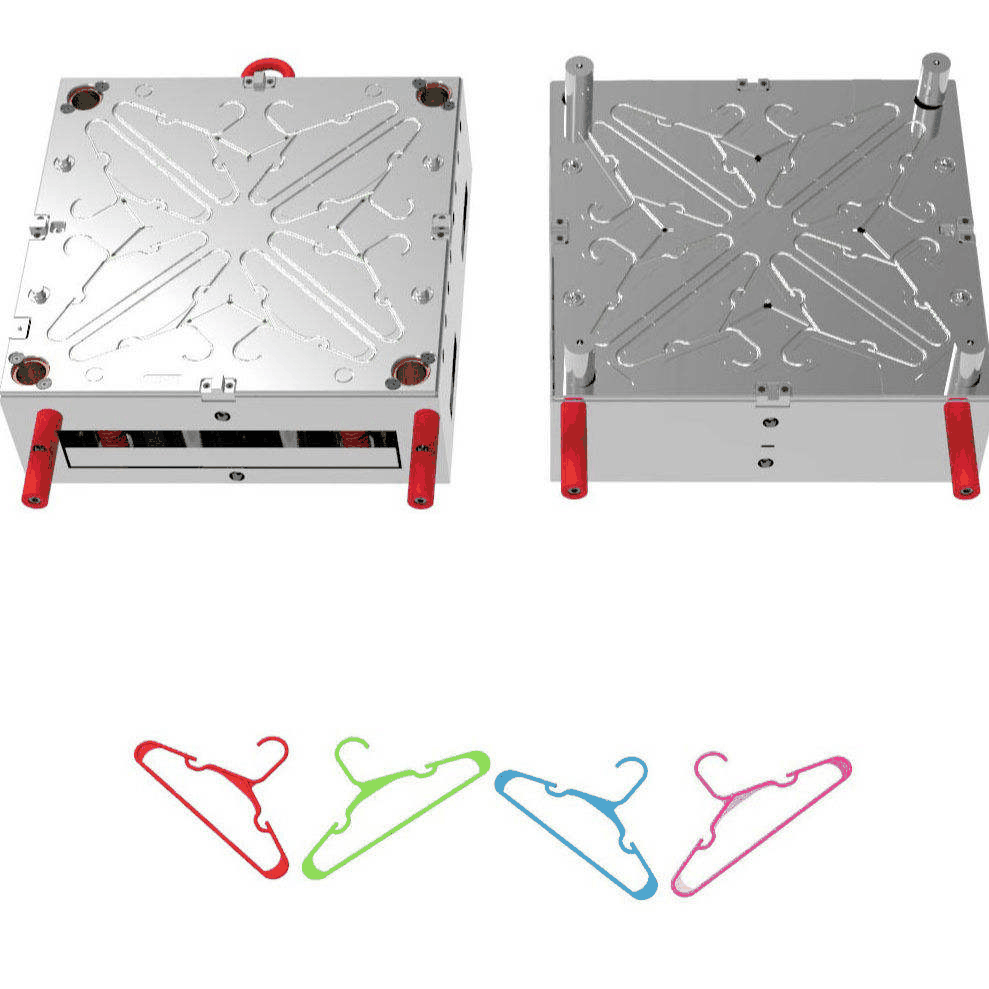
High-cavitation injection mold for plastic clothes hangers, supporting garment industry and household product production with efficient multi-cavity layout.
Plastic hangers are among the most cost-sensitive injection molded products. Multi-cavity molds producing consistent parts at fast cycle times are essential for competitive production. Hanger design ranges from simple wire-replacement shapes to complex designs with clips, notches and non-slip features.
Shengqi reviews the hanger design including overall shape, hook profile, shoulder width, bar length, clip or notch design, non-slip surface features and any metal hook overmolding requirements before mold design.
For high-volume hanger production, the mold must balance tooling cost, cycle time, material usage and part quality. Recycled material compatibility may also be a consideration.
The hook area bears the garment weight. Wall thickness, rib reinforcement and material flow at the hook-to-body transition are reviewed for strength and molding quality.
Multi-cavity hanger molds require precise runner balancing. Naturally balanced layouts with equal flow distance to each cavity ensure consistent part weight and dimensions.
Hangers must have smooth surfaces and rounded edges to avoid snagging garments. Mold polishing, parting line position and gate vestige control are quality points.
Some hangers use metal hooks insert-molded into a plastic body. Insert positioning, material bonding and cycle time for insert loading are considered in mold design.